
Cassina LC4 Leather Chaise Longue (À réglage continu) 'Noire, Durable'—Reinterpreting the 1928 Structure with Today's Materials
Furniture That Doesn't 'Force Inclination' But Rather 'Permits' It—The Structure
The LC4 does not prescribe a single posture of rest. Instead, the curved frame accepts the user's center of gravity while changing angles, and the base supports that movement in a stable manner. This structure, proposed in 1928, demonstrates that 'comfort' can begin not from the thickness of cushioning but from the logic of the frame itself. Cassina's '4 Chaise longue à réglage continu, Noire, Durable' maintains that logic while placing an all-black tone and sustainable material choices front and center. Cassina Noire, Durable MoMA Collection (LC/4, 1928)

How Cassina Made 'Re-editions' into an Industry
The reason LC4 is spoken of today as the standard for 'authentic production' lies in the manufacturing and verification system established when Cassina undertook full-scale production in 1965. Since then, through the iMaestri collection starting in 1973, Cassina has organized major 20th-century designs not as 'reprints' but as reinterpretation processes based on drawings and archives. The LC4, in turn, is positioned as a model that maintains the original proportions and structure while updating materials, finishes, and maintenance methods. Cassina iMaestri Architectural Digest (LC4 Evolution)

The Intention of 1928: Designing 'Posture' Rather Than 'Seat Surface'
According to official documentation, the LC4 was designed in 1928 and exhibited at the 1929 Paris Salon d'Automne. The key point is that rather than fixing the seating surface rigidly to dictate 'how to sit,' the frame slides smoothly to allow the recline angle to change continuously. This 'continuous adjustment' helps users not conform themselves to fixed recliner positions, but rather fine-tune their posture according to their condition on any given day. Cassina LC4 Durable Production and Date Information (MoMA)

Details Read in Noire, Durable: Making 'Frame Presence' More Distinct
The Noire version unifies the tones of the base, frame, and upholstery in black, visually emphasizing the LC4's 'separation of structure and cushioning.' The glossy chrome frame, which once created a classic impression of rising as an object in space, is toned down, and instead the outline and silhouette of the lines become clearer. Additionally, in Cassina's product guidance, recycled polyester wadding is mentioned as the filling material, approaching it as a composition that permits maintenance and replacement (sustainability often appears not in form but in manageability). Recycled Filling Material Mention (Noire, Durable) Product Positioning (Durable)
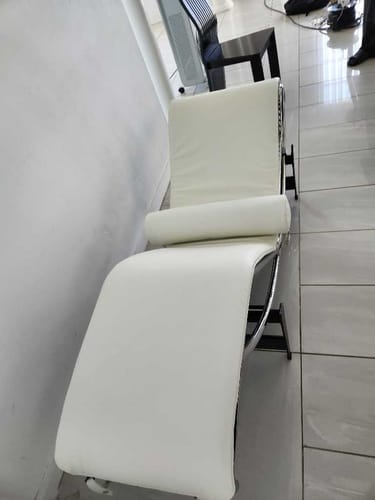
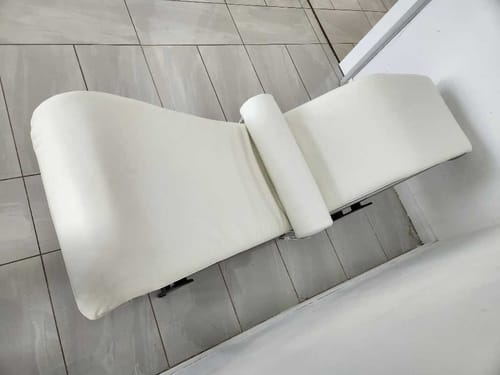
Installation Example: The 'Brightness' of the White Leather Option Makes the Structure Softer
A customer's installation review records completion in December 1, 2025. The headrest and mattress were matched in the same leather series, prioritizing the impression as a 'lounge' over the mechanical impression of the frame. The white tone makes the curves of the LC4 appear more distinct while ensuring the spatial mass doesn't become excessive.
What Space to Place It In: A 'Rest Spot' Rather Than a 'Sofa Replacement'
The LC4 carries more persuasiveness not as a replacement for main seating in a living room but as 'a place for one person to rest for extended periods' in spots like a window nook, study, or lounge corner. The Noire, Durable presents the silhouette rather than flaunting the metal frame, fitting unobtrusively into minimal interiors. Conversely, when paired with textured rugs or natural wood flooring, the frame's lines become more distinct and contrast comes alive. Product information can be found at Product Details.
#Cassina #Cassina #LC4 #Chaise Longue #Charlotte Perriand #Le Corbusier #Pierre Jeanneret #Modernism Furniture #Tubular Steel #Reclining Chair #Lounge Chair #iMaestri #Design Classic #All-Black Interior #Sustainable Design #Living Room Furniture